Juston Dea
Period 2
6/8/10
Wood vs. Metal Baseball Bats
During the semester, I wrote a blog about High School Baseball titled, “Wood Bats or Aluminum Bats for High School Baseball.” I had read an article in the sports page of the San Francisco Chronicle about a pitcher who was hit on the head by a baseball and was in critical condition in the hospital. The incident was near and dear to me because I was playing varsity baseball for Alameda High at the time. However, getting hit by a baseball is sort of a given if you play the game because sooner or later, the ball is going to take a bad bounce and end up whacking a player on the nose, hands, or body. Sometimes, you get hit by a pitched ball. Over the last three months, the blog has become my favorite because it was such a hot topic in the Bay Area and my baseball season was still going on as our team made the North Coast Sectional playoffs (NCS). I was surprised after I reread the blog that so much has changed since I read that first article. Since I play baseball, and am a pitcher as well, I see both sides of the argument, yet I feel torn between the possible solutions that have popped up. I will attempt to analyze the topic from many different angles to see if I can come up with a solution.
Earlier this year, during a high school baseball game, a 16-year-old pitcher at Marin Catholic High School was hit by a line drive from an opposing player from De La Salle High School. The pitcher was struck on the left temple with such force that he was knocked unconscious, was in critical condition in the hospital for almost a month, and currently is in rehabilitation therapy. The incident has created a huge debate on whether or not metal bats should be ban from baseball and should wood bats be used instead. Baseball’s rich tradition might lean towards going to wood bats exclusively, but safety would continue to be an issue as wood bats can splinter. Maybe the answer lies not in whether we pick metal or wood, but rather in training pitchers about how they can reduce their risk on the mound. Since protective gear is worn by certain players and umpires on the field, why not have protective gear for the pitcher. There is also possible legislation on a bill proposed by a San Rafael assemblyman that might ban metal bats in California for the next three years. If a switch to wooden bats becomes reality, what about the economics of the change, with so many school districts facing huge budget cuts. There seems to be no clear cut answers in sight, as the debate over metal or wood bats continue.
As I wrote in my blog, “Baseball is part of America’s past life and we have been using wood bats since then. To me, I think High School athletes are capable of playing and performing at their best with a wood bat… However, wood bats are not totally safe either, because they can crack or splinter on impact of a hard thrown baseball, therefore, sending a sharp wooden missile towards players and fans.” http://jud-jdizzle.blogspot.com/2010/04/wood-bats-or-aluminum-bats-for-high.html
I also wrote in my blog how wood bats would “make batters hit with better technique.” Well, I might not have thought about how well batters would hit! During the NCS playoffs, which just concluded yesterday (June 7, 2010), 6 teams from the Marin County Athletic League, or MCAL, used wood bats and none of them advanced to the finals. Some opponents commented on how easier it was to pitch to players that used wood bats, because it gave the pitchers the edge due to how “more perfect” the hitter had to hit the ball on the ‘sweet spot” of the bat. I hadn’t thought about it, but if switching to wood bats is to be the solution, giving pitchers more of an advantage, then would we see lower scoring games, would there be more shutout games (zero scores), and would it make the game not as entertaining?
Taking the other side of this issue, what about providing the pitcher with more protection, regardless of whether a metal or wooden bat is used? As I quoted in my blog, “As a pitcher, they are supposed to be trained to protect themselves after they pitch. When they follow through for their pitch, they should end up facing the plate in an athletic stance so they can react.” “On a baseball diamond, the pitcher is the closest player to the batter besides the catcher and the catcher wears protective gear so why shouldn’t the pitcher have it?” “There are many solutions to this dangerous problem but the problem is that it would ruin or compromise the traditional baseball ways of the game.”
http://jud-jdizzle.blogspot.com/2010/04/wood-bats-or-aluminum-bats-for-high.html
With baseball so rich in its traditions would proposed safety solutions mean too much change in the game of baseball as we know it?
The issue has moved from the baseball field to the league administrators, the school federations, and even the lawmakers of California. With so many newspaper articles written after the incident, the Marin County Athletic League (MCAL), which is the league Marin Catholic belongs to, decided to ban metal bats in their entire league for the remainder of the season. The banning of metal bats was also on the agenda for a North Coast Section (NCS) Board of Managers meeting held a few weeks ago. They voted to continue with metal bats for this season’s playoffs, but a change in the future might be proposed. Jared Huffman, Democrat Assemblyman from San Rafael, has drafted a bill to ban the use of non-wood bats for three years. If his bill is made into law, how will the little leagues and schools be able to pay for the purchase of new wood bats, and what do they do with the metal bats that they already have? The State budget in California has major cuts to the schools and there will be no money to fund the expense of wood bats. Also, not only is economics a problem, but the environment is in jeopardy if metal bat are banned. Wood bats are made of wood which means they come from trees and if California can only use wood bats, that is a lot of tree cutting. Whatever happened to “going green”? Probably more time will be needed to evaluate the impact of any changes made, more information will need to be collected, and more debates will occur before this issue is settled.
The unfortunate incident of the 16 year-old pitcher for Marin Catholic High School has brought a lot of debate and an eruption of new ideas regarding the use of metal or wood bats. Recently, there has been a back and forth argument on whether to switch to wood bats, or keep it the same with aluminum bats. But arguments on both sides have advantages and disadvantages. Metal bats hit too hard, wood can splinter, it’s easier for hitters to hit with metal, and wood makes players better hitters. There is probably an endless list of pros and cons on the topic. Another solution is to keep the bats the same but focus on protecting the pitcher. There are already temple guards that some pitchers wear to protect themselves and I think it should be a rule that all pitchers must wear one. But some people may think by doing so it will ruin the traditional game of baseball. Well, would you rather stick with traditional baseball and have more pitchers end up like the 16 year-old from Marin Catholic, or is better to make some sort of adjustment? Now this problem has gone to legislation and they are deciding whether to ban metal bats in the state of California. The big problem with this solution is that schools and baseball programs may not have enough money to afford buying the wood bats. There is no set solution to this problem yet, but there needs to be more time for studies and discussion.
Note: As of this final posting…The Alameda Hornet Baseball team placed second in North California Division II, finishing with a 21-8 record and as ACCAL League Champions for 2010…Go Hornets!
Tuesday, June 8, 2010

Sunday, May 23, 2010
Monthly Review HONDO
The book HONDO – Celtic Man in Motion, by John Havlicek and Bob Ryan, is an autobiographical book written by a professional basketball player who played for the Boston Celtics during the 1960’s through the 1980’s. He decided to write this book because he wanted to share with others his life and basketball journey by including all of his disappointments, failures, and successes. He talks a little about his childhood and how he was from a poor family and he learned that he had to work hard to earn everything. The main audience he wrote this book for is for the fans and followers of the Boston Celtics, the athletes who were his teammates, his opponents who he played against, and those who may have heard of him or watched him play, but really didn’t know much about his personal life. I think he does a great job explaining the game of basketball because as a basketball player myself, I can really relate to his thoughts and experiences. John was a product of this environment; humble, hardworking, honest, family oriented, and poor. The only choice he had was to earn his way since he was not about to be given opportunities easily. But when he was given an opportunity, he made sure to seize it.
At Bridgeport High School, Havlicek starred in basketball, baseball and football. An All-State selection in all three sports, he was a highly recruited quarterback who could throw the ball 80 yards. He got scholarships to many colleges and his father was confused because he thought it was weird someone would let his son go to school for free because he played basketball. But with no interest in sports or school, he let John go with no argument.
Hondo chose Ohio State but did not play football. Although he did play baseball and batted over .400 in his freshman year, he focused on basketball. A collegiate All-American, Havlicek scored 14.6 points per game in three varsity seasons, playing on Buckeyes teams with Jerry Lucas, Bobby Knight and future Celtics teammate Larry Siegfried. Havlicek's Ohio State teams compiled a 78-6 record and won an NCAA Championship in 1960. The one thing that Hondo regrets and will always be the most disappointed at was when he did not make the Olympic team in 1960. He truly believed that he should have been on the team and he was cheated because of politics in the Olympic basketball committee. He explains how he was one of the best players in the try outs and he wasn’t selected because there were other college players that had political associations with the committee.
During the course of Havlicek’s basketball career, he has had many successes. In his college career, he won a NCAA championship in 1960 (the year he didn’t get picked to be on the Olympic team.) As a rookie for the Boston Celtics, he made the rookie all-star team. The amazing part about Hondo is that he did not start the games he played. He was best known as being the “sixth man.” His coach Red Auerbach did this on purpose because usually a team has their five best players on the court as the starters. But when they substitute players, the substitute player is not as good as the starter. So when other teams made their substitutions, they lowered they’re overall abilities on the court by subbing their starters for bench players, the Celtics gained ability by putting in Hondo.
Hondo is also well known for his constant movement and stamina. He says that he developed his stamina and creative moves from when he was a small boy and he had to get to places from his home by running through the woods and dodging trees because his parents had no time to drive him and they didn’t want him riding a bicycle so very near to the freeway next to their house.
He won eight NBA championships with Boston Celtics and in 1974, he earned the NBA Finals Most Valuable Player award. Seven Times in a row he made the All NBA Second Team from 1964-1970. Then he made the All NBA First team 4 years in a row from 1971-1974.
Hondo mentions that he is very lucky to have been picked by the Celtics because they really appreciated his hard work and he fit well into their system. He also thanks the Celtics for making him a better player than he would have been if he was on another team. He learned how to be more of an offensive threat to score and to make things happens instead of just playing defensive.
Another trait that John Havlicek had was that he got the job done no matter how he did it. He didn’t care if he looked bad doing something as long as the results came out good, it wouldn’t have mattered to him. He wasn’t an egotistical person so he didn’t care about what people thought of how he looked. He was taught by the Celtics to set aside your personal goals and concentrate on what you could do for the team.
The person who enforced this idea was his coach, Red Auerbach. Most people determine a good basketball player by his or her statistics like points per game, rebounds, steals, etc. Red didn’t believe in that kind of mentality. He thought that a team could have the five best players in the world and still lose because they are only watching out for themselves and they don’t care about the team. He believed what a player provided for his or her team determined whether they were a good or great player.
John Havlicek wrote the book HONDO – Celtic Man in Motion, to share with people the journey and legacy of himself. He wrote this book for mainly people who are Celtic fans and they want to learn more about his experiences. He talks about how his childhood and how his neighborhood was poor but he learned that he had to work hard through life in order to get somewhere. He also tells his past stories about his failures and successes through his high school and college career, especially his biggest disappointment at not being chosen to play for the 1960 United States Olympic basketball team. But his biggest accomplishment was getting picked by the Boston Celtics because he believed there was no other team that could have been better match for him and he his very thankful for his coach Red Auerbach who saw his abilities put it to the fullest.
At Bridgeport High School, Havlicek starred in basketball, baseball and football. An All-State selection in all three sports, he was a highly recruited quarterback who could throw the ball 80 yards. He got scholarships to many colleges and his father was confused because he thought it was weird someone would let his son go to school for free because he played basketball. But with no interest in sports or school, he let John go with no argument.
“My dad didn’t know much about either sports or schooling. When I began to get scholarship offers from various colleges, he thought it was a little strange. Why would someone send me to school for nothing just because I played basketball well? But he certainly wasn’t going to say no.”
Hondo chose Ohio State but did not play football. Although he did play baseball and batted over .400 in his freshman year, he focused on basketball. A collegiate All-American, Havlicek scored 14.6 points per game in three varsity seasons, playing on Buckeyes teams with Jerry Lucas, Bobby Knight and future Celtics teammate Larry Siegfried. Havlicek's Ohio State teams compiled a 78-6 record and won an NCAA Championship in 1960. The one thing that Hondo regrets and will always be the most disappointed at was when he did not make the Olympic team in 1960. He truly believed that he should have been on the team and he was cheated because of politics in the Olympic basketball committee. He explains how he was one of the best players in the try outs and he wasn’t selected because there were other college players that had political associations with the committee.
“About the only unpleasant aspect of my amateur career, aside from losing two NCAA title games to Cincinnati, was my experience with the Olympic basketball committee. Not making the 1960 Olympics basketball team because of politics in choosing the team is my most bitter disappointment in sports, and I will never get over it. You get only one chance. I knew I should have been there, and I wasn’t.”
During the course of Havlicek’s basketball career, he has had many successes. In his college career, he won a NCAA championship in 1960 (the year he didn’t get picked to be on the Olympic team.) As a rookie for the Boston Celtics, he made the rookie all-star team. The amazing part about Hondo is that he did not start the games he played. He was best known as being the “sixth man.” His coach Red Auerbach did this on purpose because usually a team has their five best players on the court as the starters. But when they substitute players, the substitute player is not as good as the starter. So when other teams made their substitutions, they lowered they’re overall abilities on the court by subbing their starters for bench players, the Celtics gained ability by putting in Hondo.
“Coming off the bench mostly as a forward, he averaged 14.3 points during his rookie year, many of them coming at the receiving end of Cousy's famous passes on the fast break." I made a living off Bob Cousy," Havlicek often said.”
Hondo is also well known for his constant movement and stamina. He says that he developed his stamina and creative moves from when he was a small boy and he had to get to places from his home by running through the woods and dodging trees because his parents had no time to drive him and they didn’t want him riding a bicycle so very near to the freeway next to their house.
“I developed my stamina and ability to change directions from playing in the woods near my home, taking a path to the top of the hill and on the way down, I would not take the path but run down the hill dodging trees using different fakes and maneuvers.”
He won eight NBA championships with Boston Celtics and in 1974, he earned the NBA Finals Most Valuable Player award. Seven Times in a row he made the All NBA Second Team from 1964-1970. Then he made the All NBA First team 4 years in a row from 1971-1974.
Hondo mentions that he is very lucky to have been picked by the Celtics because they really appreciated his hard work and he fit well into their system. He also thanks the Celtics for making him a better player than he would have been if he was on another team. He learned how to be more of an offensive threat to score and to make things happens instead of just playing defensive.
“Had I not broken in with the Celtics, my game would have been stymied. My game was based on constant movement without the ball and I possessed little one-on-one ability. The Celtics used me to the best advantage. Had I gone with anyone else, I would have been little more than a mediocre ball player.”
Another trait that John Havlicek had was that he got the job done no matter how he did it. He didn’t care if he looked bad doing something as long as the results came out good, it wouldn’t have mattered to him. He wasn’t an egotistical person so he didn’t care about what people thought of how he looked. He was taught by the Celtics to set aside your personal goals and concentrate on what you could do for the team.
“One of the more interesting compliments I’ve ever been paid came when somebody said that the best thing about me was that I wasn’t afraid to look bad. If you’ve got the kind of ego which leaves you afraid to look bad, then it stands to reason that your ego won’t allow you to give yourself up by moving without the ball in order to create opportunities for someone else.”
The person who enforced this idea was his coach, Red Auerbach. Most people determine a good basketball player by his or her statistics like points per game, rebounds, steals, etc. Red didn’t believe in that kind of mentality. He thought that a team could have the five best players in the world and still lose because they are only watching out for themselves and they don’t care about the team. He believed what a player provided for his or her team determined whether they were a good or great player.
“Our coach, Red Auerbach would say, ‘Don’t bring me any statistics about how many points you scored, or how you did this or that. What did you do for the team?’”
John Havlicek wrote the book HONDO – Celtic Man in Motion, to share with people the journey and legacy of himself. He wrote this book for mainly people who are Celtic fans and they want to learn more about his experiences. He talks about how his childhood and how his neighborhood was poor but he learned that he had to work hard through life in order to get somewhere. He also tells his past stories about his failures and successes through his high school and college career, especially his biggest disappointment at not being chosen to play for the 1960 United States Olympic basketball team. But his biggest accomplishment was getting picked by the Boston Celtics because he believed there was no other team that could have been better match for him and he his very thankful for his coach Red Auerbach who saw his abilities put it to the fullest.
Wednesday, May 19, 2010
LC Letter 3
In the beginning of the last section, Hondo talks about his coach, Arnold “Red” Auerbach and the traits, abilities, and type of person he was that made him a great coach. He repeatedly said he was lucky to be coached by Red because his type of play fit in well with the type strategies that Red had. He explains how Red was a very good coach…only if you were on his team. If you were the opposing team playing against him, you would probably want to kill him. He would do things like turn off the hot water in your showers and lower the air temperature in the locker room so when you started to play, your body would not be warm and ready to play. But what Red is most famous for is his “victory cigar”. Whenever he knew that he had the lead in the fourth quarter and they were going to win, he pulled a “victory cigar” and started smoking it somewhat mock the other team that they were going to lose.
Also Hondo talks about the Celtic way, how fundamental the game was, and how it fit his style, not fancy, but smart and teamwork. More teamwork, and less ego! He talks about how their team had a lot of talent but a lot of discipline, and that’s why they were so successful. He talks about how a play is better when it’s done with affection and not hurried. He says that a play should involve all five players on the court and there shouldn’t just be one guy doing what he wants to do. If all of the players are involved, it creates more pressure on the defense because they have to be aware of 5 players rather than just focusing on one. Hondo talks about how lucky he was to play for the Celtics…while others complained about travel and money. He always looked at it from a half-full perspective…he learned to appreciate what the game was about and what the game gave him.
Also Hondo talks about the Celtic way, how fundamental the game was, and how it fit his style, not fancy, but smart and teamwork. More teamwork, and less ego! He talks about how their team had a lot of talent but a lot of discipline, and that’s why they were so successful. He talks about how a play is better when it’s done with affection and not hurried. He says that a play should involve all five players on the court and there shouldn’t just be one guy doing what he wants to do. If all of the players are involved, it creates more pressure on the defense because they have to be aware of 5 players rather than just focusing on one. Hondo talks about how lucky he was to play for the Celtics…while others complained about travel and money. He always looked at it from a half-full perspective…he learned to appreciate what the game was about and what the game gave him.
Tuesday, May 18, 2010
Pitching
Some may wonder how can pitchers in baseball get there ball to curve, sink, go left, or go right. It's all a matter of physics, the pitchers grip, on the ball and the way he throws the ball. There a few common pitches that almost most every pitcher may throe. First there is the simplest pitch which is the four seam fastball. It might be the simplest but a pitcher has to have a good fastball in order to be effective. The objective of a four seam fastball is to obviously throw it fast so the opposing batter cannot catch up with the speed of the ball. But not only is speed a factor but location is huge. a pitcher can have the hardest and fastest fast ball, but if they can't throw it as a strike, then its useless.
Another common pitch that many pitchers like to throw is the curveball. Now there are many types of curveballs depending on what type of pitcher there is. There can be a slow up to down curveball, a fast up to down curveball, a slow diagonal curveball, or fast diagonal curveball. To throw this pitch, the pitcher needs to grip the ball on one half-side of the ball and keep you middle finger and pointing finger together on a seam. when you throw the ball, the objective is to get as much spin on the ball as possible. The spin is what makes the ball move. The pitcher should flick his wrist down as if he were casting a spell on someone. the ball should feel like its slipping out of your hands and before you know it, its in the air. A curveball is somewhat hard to throw because your target is not at the strike zone. Your target is actually at the batter's head. A pitcher must throw it at the batter's head or somewhere relatively around there because when the curveball drops, it will end up in the strike zone.
The last pitch I would like to talk about is a pitch I'm trying to work on myself. It's called a splitter. Typically, it's only a good pitch if you've got bigger hands. That's because the pitch itself should be "choked" deep in the hand. This is how splitters get their downward movement. Your index and middle fingers should be placed on the outside of the horseshoe seam. The grip is firm. When throwing this pitch, throw the palm-side wrist of the throwing-hand directly at the target while keeping your index and middle fingers extended upward. Your wrist should remain stiff. This confuses many batters because when the ball is approaching the plate, it looks like a fastball right down the middle until it suddenly drops in the middle of their swing.
Another common pitch that many pitchers like to throw is the curveball. Now there are many types of curveballs depending on what type of pitcher there is. There can be a slow up to down curveball, a fast up to down curveball, a slow diagonal curveball, or fast diagonal curveball. To throw this pitch, the pitcher needs to grip the ball on one half-side of the ball and keep you middle finger and pointing finger together on a seam. when you throw the ball, the objective is to get as much spin on the ball as possible. The spin is what makes the ball move. The pitcher should flick his wrist down as if he were casting a spell on someone. the ball should feel like its slipping out of your hands and before you know it, its in the air. A curveball is somewhat hard to throw because your target is not at the strike zone. Your target is actually at the batter's head. A pitcher must throw it at the batter's head or somewhere relatively around there because when the curveball drops, it will end up in the strike zone.
The last pitch I would like to talk about is a pitch I'm trying to work on myself. It's called a splitter. Typically, it's only a good pitch if you've got bigger hands. That's because the pitch itself should be "choked" deep in the hand. This is how splitters get their downward movement. Your index and middle fingers should be placed on the outside of the horseshoe seam. The grip is firm. When throwing this pitch, throw the palm-side wrist of the throwing-hand directly at the target while keeping your index and middle fingers extended upward. Your wrist should remain stiff. This confuses many batters because when the ball is approaching the plate, it looks like a fastball right down the middle until it suddenly drops in the middle of their swing.
Monday, May 17, 2010
The Rules of Love
The rules of love are actually very simple but some people including myself, sometimes struggle. But believe that shouldn't stop two from loving each unless it's really extreme. Some of these simple rules are being yourself (don't try to do too much), show interest when you talk to your partner, try not be forceful (let her talk about herself. A relationship should be a dialogue, not a monologue.), but you can't be too quite because women don't like it when men don't act like men. And the simplest but yet hardest rule is to express your feelings to her. Tell her you love her, give her hugs, etc. To break these rules, a guy either has to be unfaithful, not interested anymore, lie, or do something to hurt the girl's feelings. There is one rule that a guy should know. Girls are not very forgiving when it comes to a relationship. If you break a rule once, the most chances she will forgive you is maybe twice at the most. After that, your pretty much toast. If a guy wants to find or keep a relationship, I think they need to be confident and they have to earn the trust of the girl. These rules are not necessarily made up by someone but to me it’s just commonsense. Seriously, if you truly love someone, you would do anything for them. If you couldn’t do that for someone then you don’t truly love them. You might think you do but the truth is you don’t. On the other side, you might truly love someone but they don’t like you. Now what do you do? As sad as it sounds, you just have to move on. It’s better being with someone who enjoys you rather than someone who’s just with you because you want them to be.
Friday, May 14, 2010
LC Letter 2
Hondo’s college career at Ohio State was very impressive… lost 6 games in three varsity seasons, was NCAA Champions his sophomore year, runner-up two years, and selected as an All-American as a senior. He played on a team with very good players as well; Jerry Lucas was an All-American who also had a long career in the NBA, Bobby Knight became one of the greatest college coaches ever, coaching at Army, Indiana, and Texas Tech, Larry Siegfried joined Havlicek on Championship Boston Celtic teams, and Joe Roberts became an assistant coach with the San Francisco Warriors, helping them win an NBA Championship in 1974. It was during a high school All-Star game that a future teammate named, Mel Nowell, who couldn’t pronounce his name, came up with the nickname, “Hondo.” Nowell decide that “Havilicek” was too difficult to say correctly, and since John resembled the movie star, John Wayne, who was starring in a new western movie, “Hondo”, he began calling Havlicek, “Hondo!”
“Mel was the one who came up with the name “Hondo” for me. When we first met during those high school All-star games, he couldn’t pronounce my name correctly. He decided that I looked like John Wayne from the side, and he said, Let’s call him ‘Hondo’ ” because that was the name of a John Wayne movie which was out at the time.One of the biggest disappointments that Hondo had as an amateur was his experience with the United States Basketball Olympic Committee. He was invited to Denver in 1960 for the Olympic trials and played very well. Unfortunately, politics got in the way. As most All-Star teams are chosen, at any level, whether it be Little League, to a World Team, there usually is some degree of politics in selecting the “All-Stars”, versus who truly are the “Best Players”. The organizers wanted each team invited to have at least one player from that team be selected. Since Jerry Lucas, his teammate at Ohio State, was chosen to the first group, Havlicek was passed over by less skilled players from other teams. From reading the passage, Havlicek describes his contempt for the Olympic Committee.
“Not making the 1960 Olympic basketball team is probably my most bitter disappointment in sports, and I will never get over it. You get only one chance. I knew I should have been there, and I wasn’t.”
Thursday, May 13, 2010
The Perfect Game
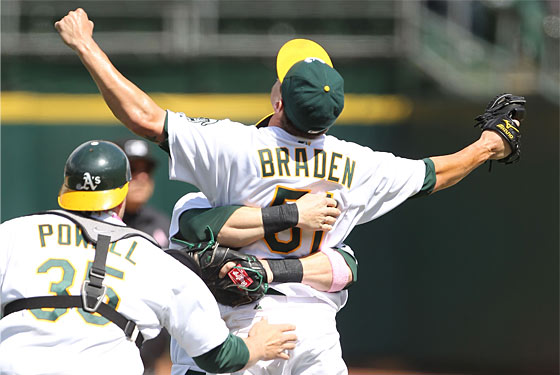
On Friday May 7, during my baseball practice, my coach gave me two A's tickets for May 9th which was mother's day. So I thought I'd take my mom to an A's game for mother's day. Recently, the A's have not been doping well at all and there has been a lack of audience attendance. I didn't think that anything exciting would happened. I just wanted to take my mom to the A's game. On Mother's Day, my mom and I went to the A's game where they were playing against the Tampa Bay Rays. The pitchers were A's young Dallas Braden vs. Tampa's flame throwing James Shields. When we got to the stadium, there were only about 1,200 people there. There's more people at school than that!!During the game, the A's pitcher, Dallas Braden was doing excellent and the Rays, who have the best record in the MLB were not doing to good. By the 7th inning I realized that the scoreboard had all zeros for Tampa Bay which means they have no hits and no runs. I got the feeling that Dallas Braden had a very good chance to complete a perfect game at the rate he was going. When the 9th Inning came around, all of were on our feet cheering for the young left handed pitcher. When the last out was made by shortstop Cliff Pennington, the crowd went crazy because they have experienced a perfect game. It was extra special because it was on Mother's Day and it was 42 years and one day since the last A's pitcher, Catfish Hunter had a perfect game.
Not only was it a special Mother’s Day for me, but it was especially a special Mother’s Day for Dallas Braden due to his rough past. When he was a senior in high school his mom past away from cancer. I think it’s truly amazing how this guy could bounce back up from adversity like that and create history for himself. I admire Dallas Braden not only for making history for pitching a perfect game, but also because he is fearless as a young player. When he yelled at Alex Rodriguez for running across his mound, he really caught my eye. I don’t know if any other pitcher would have done with Braden did. Braden was born and raised in Stockton California where it is very uneducated, high rates of crime and poverty, and with very steep taxes. When he was in high school, he was about to fail high school and was barely holding on. After his mom died, his grandma was the person who really straightened him up so he could get an education and so he could be in the major leagues. After the game, Dallas Braden went over to his grandma and gave her a big loving hug to show his respect and thanks to her. Dallas Braden gives his Grandma a pink bat every game he pitches in memory of his mom as a cancer patient. I hope he continues to succeed.
Friday, May 7, 2010
LC Letter 1
In the first chapter of Hondo, Havlicek describes how he used a dish pan to soak his injured foot to help his Boston Celtics win a Championship. You may not know who John Havlicek is because he played back in the 1960’s and 1970’s but he is truly amazing. He grew up in small, poor neighborhood in Lansing, Ohio where his mom and dad owned a grocery store. His mom was his disciplinarian who made him fix the beds, wash the dishes, and clean the floors. Literally, his house was 15 to 20 feet from route 40 so his parents wouldn’t let him ride a bike because it was too dangerous so if he wanted to go somewhere, he had to run to his destination. As he got older, he knew short cuts through the woods so he would run through the woods while practice dodging the trees and bushes. He believes that this helped him as a basketball player to run the whole game and tire his defender. Because he was poor but had good parents, he was taught to be humble, hardworking, honest, family oriented, and he knew that he had to earn his way and take advantages of opportunities given to him.
In high school, he was a three sport player. He played football, baseball, and basketball. He was excellent in all three and got a scholarship to Ohio State. His dad was confused when he heard his son say that he’s going to college for free for playing basketball but he didn’t argue. At Ohio State, he won an NCAA Championship, and was runner-up in two other years. After his college career ended, he was drafted by the Cleveland Browns for football and the Boston Celtics for Basketball. After a few weeks of playing for the Browns, Havlicek got cut and went on to play basketball where his legacy began.
In high school, he was a three sport player. He played football, baseball, and basketball. He was excellent in all three and got a scholarship to Ohio State. His dad was confused when he heard his son say that he’s going to college for free for playing basketball but he didn’t argue. At Ohio State, he won an NCAA Championship, and was runner-up in two other years. After his college career ended, he was drafted by the Cleveland Browns for football and the Boston Celtics for Basketball. After a few weeks of playing for the Browns, Havlicek got cut and went on to play basketball where his legacy began.
Tuesday, April 27, 2010
Wood Bats or Aluminum Bats for High School Baseball?
As a pitcher, they are supposed to be trained to protect themselves after they pitch. When they follow through for their pitch, they should end up facing the plate in an athletic stance so they can react. Over the course of history of baseball, there has been more protective gear for players because too many incidences happened too often. All baseball players, at every level, are required to wear a protective cup, for the obvious reasons for guarding the family jewels. I’m sure that batters have been beaned in the head by a baseball and in fact Ray Chapman was killed by a pitch in 1920. Since then batters wore helmets. Umpires wear chin guards, chest protectors, and facemasks since baseball was first invented because they have been hit by foul balls a lot. In 2007, Mike Coolbaugh, a first base coach in the minor leagues, was killed by a line drive to his head, so now the first and third base coaches are suppose to wear helmets. On a baseball diamond, the pitcher is the closest player to the batter besides the catcher and the catcher wears protective gear so why shouldn’t the pitcher have it? If people are smart enough to make bats out of metal alloys, why can’t they make a temple protector for pitchers? The mask could be made of some clear, light-weight material, such as acrylic plastic so the pitchers line of vision would not be impaired when trying to hold runners on base. One suggestion is to have longer, heavier bats so the batters cannot swing as hard. Another solution is to make the balls bigger or softer so they won’t travel as fast and they won’t hurt as much if you get hit. There are many solutions to this dangerous problem but the problem is that it would ruin or compromise the traditional baseball ways of the game.
Baseball is part of America’s past life and we have been using wood bats since then. To me, I think High School athletes are capable of playing and performing at there best with a wood bat. As a high school baseball player I think metal bats are somewhat a cheat due to the quality and technology of each bat. Some bats may not have as much “pop” as some others bats do. Most metal bats used nowadays are made from alloys so the bat can be longer, thicker, lighter, and with technology, the ball pounce of the bat as if it weren’t even there. Wood bats have a few advantages depending on what type of wood is used but it is a much smaller advantage than metal bats. Getting hit by a baseball by a metal bat is definitely dangerous and painful but one cannot say getting hit by a baseball from a wood bat traveling 90 mph or more would not hurt. I don’t know why high school and college teams are not using wood bats especially if their trying to make it to the top level where players always use wood bats. Another reason why I say wood bats should be used is because they make batters hit with better technique and it forces them to hit the ball on the “sweet spot” of the bat head. Wood bats are much safer than metal bats because they are heavier therefore the bat is not swung as fast and the ball will travel slower and not as far. However, wood bats are not totally safe either, because they can crack or splinter on impact of a hard thrown baseball, therefore, sending a sharp wooden missile towards players and fans.
Baseball is part of America’s past life and we have been using wood bats since then. To me, I think High School athletes are capable of playing and performing at there best with a wood bat. As a high school baseball player I think metal bats are somewhat a cheat due to the quality and technology of each bat. Some bats may not have as much “pop” as some others bats do. Most metal bats used nowadays are made from alloys so the bat can be longer, thicker, lighter, and with technology, the ball pounce of the bat as if it weren’t even there. Wood bats have a few advantages depending on what type of wood is used but it is a much smaller advantage than metal bats. Getting hit by a baseball by a metal bat is definitely dangerous and painful but one cannot say getting hit by a baseball from a wood bat traveling 90 mph or more would not hurt. I don’t know why high school and college teams are not using wood bats especially if their trying to make it to the top level where players always use wood bats. Another reason why I say wood bats should be used is because they make batters hit with better technique and it forces them to hit the ball on the “sweet spot” of the bat head. Wood bats are much safer than metal bats because they are heavier therefore the bat is not swung as fast and the ball will travel slower and not as far. However, wood bats are not totally safe either, because they can crack or splinter on impact of a hard thrown baseball, therefore, sending a sharp wooden missile towards players and fans.
Friday, April 23, 2010
Monthly Book Review
The book How Rude!, by Alex J. Packer, is a book that explains how to be more polite to other people and it includes very useful tips that people can use in their daily lives to better themselves. Alex J. Packer himself is a very polite man who graduated from Philips Exeter Academy, and received a PhD from Harvard University. The purpose of him writing this book was to share his ways of improving people’s mannerism and also how to handle certain situations that people may not be comfortable with. To me, I think this book was written for everyone because everybody is not perfect and everyone can learn some proper behavior and etiquette that can make them a better person. This book is very self-influencing that will change the reader’s ways of being polite.
Alex J. Packer is an extremely educated man who is well known for writing books on parenting, growing up as a teenager, and being polite. Other books that he has written include: Bringing Up Parents: The Teenager’s Handbook, 365 Ways to Love Your Child, Parenting One Day at a Time, and The Nurturing Parent. He has also written articles for magazines such as Education Bulletin, Child, Harvard Graduate School, McCall’s, U.S. News, and World Report. Besides being an author, Packer is also an educator, physiologist, and a screenwriter. Alex attended Philips Exeter Academy which is one of the elite prep schools in America, where he earned a solid education and later went to Harvard University. At Harvard, he majored in Social Relations. He was a specialist in adolescence, parent education, substance abuse, and received a PhD in Educational and Development Physiology from Boston College. Alex has been a head master for eight years at an alternative school for children at the ages of 11-15 in Washington D.C. He has served as a director of Education for the Capitol Children’s Museum and now is currently the President of FCD Educational Services, Inc., a leading Boston-based provider of drug education programs to schools and colleges world-wide. Since the book was dedicated to his sister…”For my sister Janet…who, except for call waiting, is impeccably polite”, Alex most likely wrote How Rude! The Teenager’s Guide to Good Manners, Proper Behavior, and Not Grossing People Out because of his own family and siblings experiences along with his educational experiences as a professional teacher, counselor, and administrator. Also, he has a light-hearted, laugh-at-myself, humorous approach to his writing. For some personal reason, Packer likes to keep a low profile for himself. He refuses to take photos or sign autographs, and makes a point of not being recognized so people won’t stop to ask him questions while he is in a restaurant about proper manners.
Since Alex has been an educator for most of his life, that’s probably the main reason for writing the book. His experiences in education, especially in his interactions with youth, has forged a desire to extend his knowledge of how a family unit operates, how they deal with each other on a daily basis, how they settle disputes, and how they compromise, all lead to how each family member treats people outside of their home. Also, the reverse is true as well, that social interactions with friends, acquaintances, schoolmates, teachers, coaches, co-workers, bosses, the waiter at a restaurant, the check person at Safeway, just about everyone you can come in contact with on a daily basis, can translate to how the family member modifies their behavior and interactions with their family. The deeper, more universal message that Alex sends to his readers is that if everyone treats each other with respect and politeness, with understanding and patience, that all relationships – child to parent, parent to child, sibling to sibling, relative to relative, friend to adult, teacher to student, coach to umpires, referees to players, men to women, gays to straights, Americans to Iranians, Countries to Countries, and so on can exist and communicate without feeling uneasy or with fear. Another reason why I think Alex wrote the book is because he believes that he has something to offer people of all ages about being polite. Alex even includes a “List of Reproducible Pages” and some are for everybody like “The Ten Commandments of Telephone Etiquette”, some are for children such as, “The Thirty Commandments of Classroom Etiquette for Students” and others are for adults like, “The Thirty Commandments of Classroom Etiquette for Teachers.” This explains that everybody has something they can work on to better their lifestyle. I’m not saying that Alex is trying to make us feel like we don’t know anything but I get the feeling that he wants to share some insights in his book so readers can benefit from what he has experienced. I believe he accomplished his goal by writing a humorous book about manners, on a subject that normally is very dry and serious.
In my opinion, I think Alex J. Packer wrote this book for everyone, not one particular audience, because I believe everybody could read this book and make good use of it. Packer mostly writes about mannerism but sometimes he has a variety of topics to enjoy so it isn’t focused on one particular group of people. He has family life, business interviews, romance, friendship, and many other diverse subjects. Not only do I think everybody should read this book but I think everybody needs to read this book. I say this not because I think everyone has bad manners, but because everyone can improve on something in their lives by reading this book. Except there is a particular group that I think all of them need to read this book because they act rude all the time and that would be, high school students. When kids get to high school, they become young adults and are supposedly supposed to become more mature. In some cases this is true but in many others it isn’t. When teens get to high school, they become more arrogant and self centered because they think they are already mature enough to be their own selves but the truth is that they are no where close. As a high school student, I admit that I have had my moments. For the high school students who do read this book, it will really make them more careful about what they say to certain people, how they treat others, and especially what we do as an individual. The only problem is that the young adults who don’t have manners have probably heard the same advice Alex gives by others around them but they don’t really listen to what they are saying or they never cared to change to be a better a person. In the end, it really depends on the individual to take the advice and apply their lives or else it will be useless knowledge. I would recommend his book highly to people of all ages, to the already prim and proper to the most gross and unsophisticated slobs of the world.
Alex J. Packer did a great job writing this book. He really guides the read with directions to become a more mannerable person and includes many real life examples. Packer succeeded in spreading his ideas of being polite and acting correctly in certain situations. This book was written to be read by everyone and if everybody read this book, I believe the world would be a much better place than it is currently.
Alex J. Packer is an extremely educated man who is well known for writing books on parenting, growing up as a teenager, and being polite. Other books that he has written include: Bringing Up Parents: The Teenager’s Handbook, 365 Ways to Love Your Child, Parenting One Day at a Time, and The Nurturing Parent. He has also written articles for magazines such as Education Bulletin, Child, Harvard Graduate School, McCall’s, U.S. News, and World Report. Besides being an author, Packer is also an educator, physiologist, and a screenwriter. Alex attended Philips Exeter Academy which is one of the elite prep schools in America, where he earned a solid education and later went to Harvard University. At Harvard, he majored in Social Relations. He was a specialist in adolescence, parent education, substance abuse, and received a PhD in Educational and Development Physiology from Boston College. Alex has been a head master for eight years at an alternative school for children at the ages of 11-15 in Washington D.C. He has served as a director of Education for the Capitol Children’s Museum and now is currently the President of FCD Educational Services, Inc., a leading Boston-based provider of drug education programs to schools and colleges world-wide. Since the book was dedicated to his sister…”For my sister Janet…who, except for call waiting, is impeccably polite”, Alex most likely wrote How Rude! The Teenager’s Guide to Good Manners, Proper Behavior, and Not Grossing People Out because of his own family and siblings experiences along with his educational experiences as a professional teacher, counselor, and administrator. Also, he has a light-hearted, laugh-at-myself, humorous approach to his writing. For some personal reason, Packer likes to keep a low profile for himself. He refuses to take photos or sign autographs, and makes a point of not being recognized so people won’t stop to ask him questions while he is in a restaurant about proper manners.
Since Alex has been an educator for most of his life, that’s probably the main reason for writing the book. His experiences in education, especially in his interactions with youth, has forged a desire to extend his knowledge of how a family unit operates, how they deal with each other on a daily basis, how they settle disputes, and how they compromise, all lead to how each family member treats people outside of their home. Also, the reverse is true as well, that social interactions with friends, acquaintances, schoolmates, teachers, coaches, co-workers, bosses, the waiter at a restaurant, the check person at Safeway, just about everyone you can come in contact with on a daily basis, can translate to how the family member modifies their behavior and interactions with their family. The deeper, more universal message that Alex sends to his readers is that if everyone treats each other with respect and politeness, with understanding and patience, that all relationships – child to parent, parent to child, sibling to sibling, relative to relative, friend to adult, teacher to student, coach to umpires, referees to players, men to women, gays to straights, Americans to Iranians, Countries to Countries, and so on can exist and communicate without feeling uneasy or with fear. Another reason why I think Alex wrote the book is because he believes that he has something to offer people of all ages about being polite. Alex even includes a “List of Reproducible Pages” and some are for everybody like “The Ten Commandments of Telephone Etiquette”, some are for children such as, “The Thirty Commandments of Classroom Etiquette for Students” and others are for adults like, “The Thirty Commandments of Classroom Etiquette for Teachers.” This explains that everybody has something they can work on to better their lifestyle. I’m not saying that Alex is trying to make us feel like we don’t know anything but I get the feeling that he wants to share some insights in his book so readers can benefit from what he has experienced. I believe he accomplished his goal by writing a humorous book about manners, on a subject that normally is very dry and serious.
In my opinion, I think Alex J. Packer wrote this book for everyone, not one particular audience, because I believe everybody could read this book and make good use of it. Packer mostly writes about mannerism but sometimes he has a variety of topics to enjoy so it isn’t focused on one particular group of people. He has family life, business interviews, romance, friendship, and many other diverse subjects. Not only do I think everybody should read this book but I think everybody needs to read this book. I say this not because I think everyone has bad manners, but because everyone can improve on something in their lives by reading this book. Except there is a particular group that I think all of them need to read this book because they act rude all the time and that would be, high school students. When kids get to high school, they become young adults and are supposedly supposed to become more mature. In some cases this is true but in many others it isn’t. When teens get to high school, they become more arrogant and self centered because they think they are already mature enough to be their own selves but the truth is that they are no where close. As a high school student, I admit that I have had my moments. For the high school students who do read this book, it will really make them more careful about what they say to certain people, how they treat others, and especially what we do as an individual. The only problem is that the young adults who don’t have manners have probably heard the same advice Alex gives by others around them but they don’t really listen to what they are saying or they never cared to change to be a better a person. In the end, it really depends on the individual to take the advice and apply their lives or else it will be useless knowledge. I would recommend his book highly to people of all ages, to the already prim and proper to the most gross and unsophisticated slobs of the world.
Alex J. Packer did a great job writing this book. He really guides the read with directions to become a more mannerable person and includes many real life examples. Packer succeeded in spreading his ideas of being polite and acting correctly in certain situations. This book was written to be read by everyone and if everybody read this book, I believe the world would be a much better place than it is currently.
Tuesday, April 20, 2010
How Rude! #3
In the last section of the book, I read most of the “Talking Headiquette”, “You Are What You Wear”, and some of “AHH, AHH, AHH - CHOOOOOO.” “Talking Headiquette” was very useful to me because I am not a very good at talking to other people I am not familiar with. I wanted to read this to learn how to start a good conversation with someone that I don’t know or just met. Normally, when I try to create a conversation, the hardest part for me, is to start the conversation. The book says to start the conversation by asking an open ended question such as “Wow this band is good. Where do you think they’re from?” Instead of asking a yes or no question like, “Do you like this band?” This is the reason why people have conversations. A conversation is made of two people so you want both of the persons at an equal amount of talking. You can find out someone’s personality after your first conversation with them. If they are cocky and overpowering, they will try to take over the conversation, but if they are quiet and don’t converse, then they are most likely boring or aren’t interested in talking to you, or possibly just very shy.
Although I don’t believe that what you wear describes who you are, I still think that there are guidelines that people should consider for different occasions. You will be amazed about how many people don’t know what to wear on certain events such as a wedding, funeral or just a casual party. The book instructs to first think about the event. Will it be casual, semiformal, or formal? Most people don’t have a problem with formal because it’ pretty straight forward. Men wear shirt and tie with nice dress pants and maybe suit jacket. Ladies can wear a dress or a suit usually with high heels. Depending who you are, casual can mean a lot of things. Some teens may think casual is a comfortable pair of blue jeans with a well fitted T-shirt, sneakers and maybe a baseball hat. Others may think casual is a black jacket with spikes on its shoulders, underneath, a black T-shirt with skulls all over it, black tight jeans, black sneakers and since they love the color black, they have a black backpack. Nothings wrong with either of these because it is truly your personal preference. But the only thing that is troublesome is the person’s image. The first teen described may just be an average school boy that has average grades and plays on the JV soccer team. The other one may have a 4.5 GPA and plays for the varsity baseball team. But when you look at them together, a person would most likely think the exact opposite. I am not trying to stereotype but I believe that image helps.
Although I don’t believe that what you wear describes who you are, I still think that there are guidelines that people should consider for different occasions. You will be amazed about how many people don’t know what to wear on certain events such as a wedding, funeral or just a casual party. The book instructs to first think about the event. Will it be casual, semiformal, or formal? Most people don’t have a problem with formal because it’ pretty straight forward. Men wear shirt and tie with nice dress pants and maybe suit jacket. Ladies can wear a dress or a suit usually with high heels. Depending who you are, casual can mean a lot of things. Some teens may think casual is a comfortable pair of blue jeans with a well fitted T-shirt, sneakers and maybe a baseball hat. Others may think casual is a black jacket with spikes on its shoulders, underneath, a black T-shirt with skulls all over it, black tight jeans, black sneakers and since they love the color black, they have a black backpack. Nothings wrong with either of these because it is truly your personal preference. But the only thing that is troublesome is the person’s image. The first teen described may just be an average school boy that has average grades and plays on the JV soccer team. The other one may have a 4.5 GPA and plays for the varsity baseball team. But when you look at them together, a person would most likely think the exact opposite. I am not trying to stereotype but I believe that image helps.
Tuesday, April 13, 2010
Schindler's List

Today, the whole sophomore class watched the movie, Schindler's List. People think of Schindler's List as a horrifying and gruesome but after watching it myself, I think it is an excellent movie. Probably one of the best movies I've seen yet. Steven Spielberg does such a great job showing the tension and fear of the Jews that the audience has the same feeling. To be honest, i did not know that much about the Holocaust until I watched the movie. I only knew the general situation and maybe some minor details. I didn't even know who Schindler was. Another one of my favorite movies is also about the Holocaust called Valkyrie was very similar to Schindler's List in the way that Claus von Stauffenberg was trying to kill Hitler to end the war so there would be no more killings. Except in Schindler's List, Schindler bought the Jews himself and tried his best to save them. At the end of the film, he said that he failed and he could have saved more but I think he was a good enough man just to save the 1,100 Jews he did save. The little things that he did may seem not important to others but they were amazing many more. The reason why I idolize Oskar Schindler is because he had a heart of his own and followed it instead of being stubborn like all the other Nazi soldiers. That was the only difference between him and the others. The others knew about what was happening but they were scared they would be punished if they did not follow the "system".
Schindler's List gives us three major stories and a host of minor ones. First and foremost, it tells the tale of the Holocaust, presenting new images of old horrors. These are as ghastly and realistic as anything previously filmed, and Spielberg emphasizes the brutality of the situation by not pulling punches when it comes to gore. The blood, inky rather than crimson in stark black-and-white, fountains when men and women are shot in the head or through the neck. The second story is that of Oskar Schindler, the Nazi businessman who saved 1,100 Jews from death. Schindler starts out as a self-centered manufacturer, concerned only about making money. He hires Jews because they're cheap, not because he likes them. But his perspective changes, and he risks losing everything to save as many lives as he can. His eventual lament that he couldn't save more is heartbreaking. The third story belongs to Amon Goeth, the Nazi commander of Krakow, a man who teeters on the brink of madness. Despite his intense hatred for Jews, he is inexplicably attracted to his Jewish housekeeper, Helen Hirsch . The amazing part is that it describes the situations in a Disgusted by his feelings, he lashes out at her with a display of violence that is almost Scorsese-like in its blunt presentation. As written, Goeth could easily have become a conscienceless monster, but Spielberg works carefully to show unexpected depth and complexity to his character. Often, the experiences of the minor characters provide the most lasting images. Helen's story is memorable, as is the plight of young Danka Dresner and her mother as they strive to avoid death while staying together. There's a Jewish couple that marries in the Plaszow camp, even though their chances of survival are dim, and a Rabbi who survives a close encounter with a Nazi gun.
Tuesday, April 6, 2010
How Rude! #2
The second section in the book to me had more of a sensitive feeling and focused on decision making. The parts in the section that I really liked reading about was “Handling Friendship Problems”, “The Etiquette of Romance”, and pretty much the whole section on “Eat, Drink and Be Wary.” The decision making part really struck me because it is amazing how simple the author put it but yet people make things so difficult which causes a lot of problems. But it was good that I read this or else I would have never known what to do if I were put in a situation where I had a difficult choice to make. Friendship problems was more of an emergency read so I won’t be confused when one of my friends and I have a conflict which I hope never happens. The book suggest to first look at yourself and see if you did something or said something to cause a problem. If not then ask others if something else is bothering your friend and he or she is just stressed. It also taught me to look at the big picture and by losing a friend might just have been meant to be. I read the love etiquette part because it could be very useful when meeting someone you love and you want to create a solid foundation for a strong relationship. I read about eating etiquette because I thought it would be useful when being at a formal event and you had to be on your best eating behavior.
Love etiquette is very simple. The main statement the book says is to “be you.” If a person can’t love you for who you really are, then they don’t actually love you. But if you can feel comfortable and not be afraid to make a mistake or act a certain way, then that would allow another person to see, and possibly love, the “real you”. As a picky eater, I could use some tips that can hide my pickiness in a formal event so I don't seem rude by not eating the foods I don't enjoy. The “Eat, Drink and Be Wary” section was very ironic in a sense that it’s teaching you to be rude in order to have manners. For example, if I had to eat lamb with brussels sprouts which I absolutely can’t stand, I can’t just not eat it because that would be extremely rude. Instead, I could eat as much as could until I really can’t take anymore and then as the book says, move your food around, and hide some of the food anyway possible. People will pay attention to the surface area of your plate and if your plate is messy and shuffled, it’ll seem like you had a good meal.
Love etiquette is very simple. The main statement the book says is to “be you.” If a person can’t love you for who you really are, then they don’t actually love you. But if you can feel comfortable and not be afraid to make a mistake or act a certain way, then that would allow another person to see, and possibly love, the “real you”. As a picky eater, I could use some tips that can hide my pickiness in a formal event so I don't seem rude by not eating the foods I don't enjoy. The “Eat, Drink and Be Wary” section was very ironic in a sense that it’s teaching you to be rude in order to have manners. For example, if I had to eat lamb with brussels sprouts which I absolutely can’t stand, I can’t just not eat it because that would be extremely rude. Instead, I could eat as much as could until I really can’t take anymore and then as the book says, move your food around, and hide some of the food anyway possible. People will pay attention to the surface area of your plate and if your plate is messy and shuffled, it’ll seem like you had a good meal.
Monday, April 5, 2010
How Rude! #1
Dear LindeFURD,
I wanted to read this book for a couple reasons. First I wanted to read so I could learn how to be more manner-able with my actions so I don't act like a jerk around others. Also I wanted to read this so in the future, I could use some of these tips for important events such as a job interview. The main sections that I enjoyed were, “Having Manners vs. Being Fake”, “An Introduction to Introductions”, and “Applying for a Job.” I liked the section, “Having Manners vs. Being Fake” because people in this world sometimes try too hard to be polite and end up annoying people instead. There is a very fine line between being nice and being nice because you want to "seem" like a good person. For example, someone drops their pencil during class and it lands near another person's feet. The fake person would first look who the person's pencil is and if it was a person he or she knew they would pick it up. But if they didn't know the other person, they wouldn't. Another aspect of this is the audience. Say someone drops their books in the middle of passing period when everyone sees it and I go to help them. But if I were to not do the same if there was nobody around, that would be considered fake.
I read “An Introduction to Introductions” not because I necessarily liked it, but because it was something I have to improve on as an individual. Sometimes I get shy around people I don't know and I don't know how to introduce myself and if I do, I feel awkward doing it. This section really helped me to feel more comfortable introducing myself and to other people. I also read “Applying for a Job” because I thought it could be very useful in the future. Although I have had job interviews for a Counselor in Training summer job, I wish I had read these tips a little sooner to practice them in my past job interviews, but its better late than never.
I wanted to read this book for a couple reasons. First I wanted to read so I could learn how to be more manner-able with my actions so I don't act like a jerk around others. Also I wanted to read this so in the future, I could use some of these tips for important events such as a job interview. The main sections that I enjoyed were, “Having Manners vs. Being Fake”, “An Introduction to Introductions”, and “Applying for a Job.” I liked the section, “Having Manners vs. Being Fake” because people in this world sometimes try too hard to be polite and end up annoying people instead. There is a very fine line between being nice and being nice because you want to "seem" like a good person. For example, someone drops their pencil during class and it lands near another person's feet. The fake person would first look who the person's pencil is and if it was a person he or she knew they would pick it up. But if they didn't know the other person, they wouldn't. Another aspect of this is the audience. Say someone drops their books in the middle of passing period when everyone sees it and I go to help them. But if I were to not do the same if there was nobody around, that would be considered fake.
I read “An Introduction to Introductions” not because I necessarily liked it, but because it was something I have to improve on as an individual. Sometimes I get shy around people I don't know and I don't know how to introduce myself and if I do, I feel awkward doing it. This section really helped me to feel more comfortable introducing myself and to other people. I also read “Applying for a Job” because I thought it could be very useful in the future. Although I have had job interviews for a Counselor in Training summer job, I wish I had read these tips a little sooner to practice them in my past job interviews, but its better late than never.
Thursday, April 1, 2010
Blog Review/Goals fo the Fourth Quarter
During the last quarter, i mainly focused on writing about current events, my thoughts and emotions, and some debate topics that i wanted to share to others. I like writing blogging about current events so i wont forget about an exciting or memorable moment in my lifetime. I think my favorite blog post has got to be the Alameda vs. Northgate NCS game because it was the first high school basketball playoff game I've ever been in and i got to express my emotions about the game. I am also thinking about colleges i want to go to and how i can get in. currently, i am trying to pick out my school schedule for next in order to succeed so i can have a chance of making it to a college that i would like to go. I will most likely start to begin writing more on colleges because i need to start focusing on applications and SATs for next year. I kinda was thinking about being some sort of scientists or engineer so i want to focus on my math and science. I am most likely going to take pre calculus and AP environmental science(APES). After talking to my older sister who is doing very well at the University of California at San Diego (UCSD) and my upper class men friends and they all said that APES was hard work but it's a class worth taking. Next year is gonna be a very busy year for me due to the amount of work loads i will be getting and the preparations for college. Me and my parents are debating whether or not i should take SAT classes in the summer or during the school year. I prefer taking them in the summer so it wont interfere with my sports during the regular school year. But the only problem with this is that i might forget the material that i learn over the summer time. Sports is another problem. this year i have chemistry for my sixth period class. The problem with that is that when it's baseball season, i have to leave early every game whether it's a home or an away game and we have two games a week which means i am missing two classes every week. Next year i am trying to work my schedule out so i don't have a class that is very important to me for my sixth period class.
I truly believe that i have reached my third quarter goals and i have more for this quarter. This fourth quarter, i want to work on my writing fluency and making my sentences better flowing so it's easier to read and comprehend. My writing can sometimes seem very choppy which makes it confusing and i need to fix that in order to get a good score on my SAT essay that i will be taking next year. I really hope i can finish this last quarter off with a strong, solid foundation.
I truly believe that i have reached my third quarter goals and i have more for this quarter. This fourth quarter, i want to work on my writing fluency and making my sentences better flowing so it's easier to read and comprehend. My writing can sometimes seem very choppy which makes it confusing and i need to fix that in order to get a good score on my SAT essay that i will be taking next year. I really hope i can finish this last quarter off with a strong, solid foundation.
Sunday, March 21, 2010
Monthly Book Review
I read a book written by Aldous Huxley titled Brave New World, which is a fantasy of the future that makes the reader open their mind and guides them through a journey of a world that you would never imagine. It is a world where no one is born from their mother, where every human is made in a laboratory, with their sex, intelligence, and physical strength all determined by the scientists that create them. I think the most interesting character in the novel would have to be Bernard Marx. I think he was one of the most dynamic characters throughout the book. Aldous Huxley’s youth and parental surroundings had a great effect on him writing this book and it may have had a lot to do with his personal life. Huxley’s purpose in writing this book was to send a message that life can never be perfect and even if people try to make it perfect and stable, there will still be conflicts and problems. I think Huxley does a great job in doing this.
Bernard Marx is an interesting and suspicious character. In the beginning of the novel he seems somewhat lost and confused about himself and he even wished he was a different type of caste. He struggles a lot between his emotions, love, and his personal features. After he finds out that the Director is going to exile him to Iceland, he finds revenge to embarrass the Director in front of the whole hatchery. After he succeeds, he realizes that nothing has really changed and he gets more discontented about himself due to jealousy towards his love, Lennina. Bernard struggles throughout the book with keeping his emotions within him. The Director gets mad at Bernard for expressing his feelings toward the real world. John and Helmholtz Watson are the only ones who seem to agree with his feelings. After he finds out that the Director is going to exile him to Iceland, he uses newly acquired knowledge that the Director has had sex, has a son, locates the son and the mother while on a visit to the Reservation, and plans revenge to embarrass the Director in front of the whole hatchery. He at first succeeds, gaining friends and being the toast of the parties he attends, but he does not succeed in the long run, therefore his perception and popularity goes down even more. Meanwhile, John, the Director’s accidental son starts to fall in love with Lennina and Lennina starts to feel the same towards John. Bernard thinks she is in love with him but she only uses him to take a break from her relationship with Henry Foster. Lennina thinks that Bernard is strange, short, and fat but in the novel she seems just as awkward as Bernard. She is happy to use him for her own social gain, but she doesn’t have the emotional investment in him that she does in John. Even though Bernard is the only person from the “New World” to express his feelings, he seems to never gain respect and continues to be frowned upon.
Aldous Huxley was born and raised in England and was the third son to Leonard Huxley and Julia Arnold. At an early age, Huxley began his learning in his father's botanical laboratory and was home schooled by his mother at a school named Hillside. After college, Huxley worked at Brunner and Mond chemical plant in Billingham and that is were he started writing the book, Brave New World. Huxleys ideas mainly came from his family’s and personal experience. Aldous Huxley’s Grandfather, Thomas Huxley was a biologist and a true believer in Darwinism. In the book, it totally goes against the Darwin ways in that people are chosen how they live instead of making they're own way of living and surviving (survival of the fittest). Aldous Huxley writes about how people are literally made from labs and are selected to be average, stupid, or smart. Huxley’s family life inspired many of writings because they were all either scientists or teachers so he was surrounded by new ideas and knowledge. Huxley had several books written about the future and Brave New World is still one of his most famous books. As a young adult, Aldous was involved in some major academic circles and for the most thrived in all of them. During World War I Huxley did not do too much writing but instead worked as a farm laborer. In 1937, Huxley moved to Hollywood California and he met a lot of new people who helped him create new ideas for his books. After World War II, Huxley tried to get a United States citizenship but he kept getting denied because he said that he would not take up in arms to defend the United States of America. Nonetheless he stayed in America and went through many tragic marriages. On November 22nd, 1963, at age 69, Aldous Huxley died due to cancer.
I think that Huxley wrote this book for many purposes. First, I think he wrote it to give his readers a possible feeling for the future and let them think how it could be bad or how it could be good. Personally, I would not like the future to be like this because I would not want to be a living organism that can’t think, feel, or achieve things on my own. It would also be very boring living under a strict, stable environment that does not allow you to express your feelings towards situations that you know are wrong and should not be done. I also wouldn’t want to take a drug such as soma to relieve me from my struggles. I would rather feel angry and learn from my mistakes than staying the same person by taking a drug that is supposedly used to better your life. To me, that’s a copout. In the book, the use of soma reflects the New Worlds source of religion, a tool to keep the society controlled and stable. Another reason why I think Huxley wrote this book was to express his feelings on the opposing side of his family’s scientific life. As I said earlier, most of his family was into Darwinism and the study of the human body. During the time this book was published was about the time when people believed in the Darwinist theories. I think that Huxley wanted to go out of the box and see what it would be like if there was a society that was the opposite of the theories that everyone believed. Rather than survival of the fittest, an Alpha caste of very bright, intellectuals could be created to be the leaders. Rather than having society evolved and adapt to their surrounding environment, create five permanent levels of society that structurally continues forever. If anyone starts thinking or feeling unhappy or frustrated in their position, soma is there as a “fix all” drug to bring them back to the fold. Huxley published Brave New World in 1932, and since students, like myself are still reading and writing essays on his book, he definitely has achieved his purpose in how science can affect the future of society.
The book Brave New World by Aldous Huxley is written in creative, scientific, and emotional ways to give the reader a taste of what the future might be like. The way he describes and shapes one of his main characters, Bernard Marx is so incredible that it makes the reader feel as if they were in the book. His personal backgrounds from his parents to his youth guided him to his success in this book. I believe that Huxley has done a fantastic job of getting his views across. I am excited to reading more of his novels.
Bernard Marx is an interesting and suspicious character. In the beginning of the novel he seems somewhat lost and confused about himself and he even wished he was a different type of caste. He struggles a lot between his emotions, love, and his personal features. After he finds out that the Director is going to exile him to Iceland, he finds revenge to embarrass the Director in front of the whole hatchery. After he succeeds, he realizes that nothing has really changed and he gets more discontented about himself due to jealousy towards his love, Lennina. Bernard struggles throughout the book with keeping his emotions within him. The Director gets mad at Bernard for expressing his feelings toward the real world. John and Helmholtz Watson are the only ones who seem to agree with his feelings. After he finds out that the Director is going to exile him to Iceland, he uses newly acquired knowledge that the Director has had sex, has a son, locates the son and the mother while on a visit to the Reservation, and plans revenge to embarrass the Director in front of the whole hatchery. He at first succeeds, gaining friends and being the toast of the parties he attends, but he does not succeed in the long run, therefore his perception and popularity goes down even more. Meanwhile, John, the Director’s accidental son starts to fall in love with Lennina and Lennina starts to feel the same towards John. Bernard thinks she is in love with him but she only uses him to take a break from her relationship with Henry Foster. Lennina thinks that Bernard is strange, short, and fat but in the novel she seems just as awkward as Bernard. She is happy to use him for her own social gain, but she doesn’t have the emotional investment in him that she does in John. Even though Bernard is the only person from the “New World” to express his feelings, he seems to never gain respect and continues to be frowned upon.
Aldous Huxley was born and raised in England and was the third son to Leonard Huxley and Julia Arnold. At an early age, Huxley began his learning in his father's botanical laboratory and was home schooled by his mother at a school named Hillside. After college, Huxley worked at Brunner and Mond chemical plant in Billingham and that is were he started writing the book, Brave New World. Huxleys ideas mainly came from his family’s and personal experience. Aldous Huxley’s Grandfather, Thomas Huxley was a biologist and a true believer in Darwinism. In the book, it totally goes against the Darwin ways in that people are chosen how they live instead of making they're own way of living and surviving (survival of the fittest). Aldous Huxley writes about how people are literally made from labs and are selected to be average, stupid, or smart. Huxley’s family life inspired many of writings because they were all either scientists or teachers so he was surrounded by new ideas and knowledge. Huxley had several books written about the future and Brave New World is still one of his most famous books. As a young adult, Aldous was involved in some major academic circles and for the most thrived in all of them. During World War I Huxley did not do too much writing but instead worked as a farm laborer. In 1937, Huxley moved to Hollywood California and he met a lot of new people who helped him create new ideas for his books. After World War II, Huxley tried to get a United States citizenship but he kept getting denied because he said that he would not take up in arms to defend the United States of America. Nonetheless he stayed in America and went through many tragic marriages. On November 22nd, 1963, at age 69, Aldous Huxley died due to cancer.
I think that Huxley wrote this book for many purposes. First, I think he wrote it to give his readers a possible feeling for the future and let them think how it could be bad or how it could be good. Personally, I would not like the future to be like this because I would not want to be a living organism that can’t think, feel, or achieve things on my own. It would also be very boring living under a strict, stable environment that does not allow you to express your feelings towards situations that you know are wrong and should not be done. I also wouldn’t want to take a drug such as soma to relieve me from my struggles. I would rather feel angry and learn from my mistakes than staying the same person by taking a drug that is supposedly used to better your life. To me, that’s a copout. In the book, the use of soma reflects the New Worlds source of religion, a tool to keep the society controlled and stable. Another reason why I think Huxley wrote this book was to express his feelings on the opposing side of his family’s scientific life. As I said earlier, most of his family was into Darwinism and the study of the human body. During the time this book was published was about the time when people believed in the Darwinist theories. I think that Huxley wanted to go out of the box and see what it would be like if there was a society that was the opposite of the theories that everyone believed. Rather than survival of the fittest, an Alpha caste of very bright, intellectuals could be created to be the leaders. Rather than having society evolved and adapt to their surrounding environment, create five permanent levels of society that structurally continues forever. If anyone starts thinking or feeling unhappy or frustrated in their position, soma is there as a “fix all” drug to bring them back to the fold. Huxley published Brave New World in 1932, and since students, like myself are still reading and writing essays on his book, he definitely has achieved his purpose in how science can affect the future of society.
The book Brave New World by Aldous Huxley is written in creative, scientific, and emotional ways to give the reader a taste of what the future might be like. The way he describes and shapes one of his main characters, Bernard Marx is so incredible that it makes the reader feel as if they were in the book. His personal backgrounds from his parents to his youth guided him to his success in this book. I believe that Huxley has done a fantastic job of getting his views across. I am excited to reading more of his novels.
Lit Circle letter #3
The last section of the book, Brave New World had to be the most emotional and intense part of the book. In the section, Aldous Huxley seems to try to emphasize the ways that the Brave New World people are lost in the ways that John is telling them. He believes that they should feel and express their feelings and states that Soma is poison. I think John would be very correct if he was talking to his own normal people but these people in the Brave New World are confused and think he is insane. They are not suppose to feel anything and when they start to feel emotion they take Soma to regain their control. In the book, John was talking to Mond about the ways of Soma. Mond knows that these people are awkward to normal people. He knows a lot of things about the real life but cannot tell others. Mond describes Soma as christianity. "Christianity without tears—that’s what soma is."
John is not suppose to read Shakespeare to others because it makes them emotionally exposed about love, frustration,or sadness but he continues to read verses of Romeo and Juliet to Lennina who constantly tries to seduce John. John’s struggle with his physical desires, first introduced on the Reservation, continues when Lenina tries to seduce him. He insists on seeing Lenina as a pure, virginal woman, possessed of complete sexual modesty. To John, Lenina is only an abstract rendering of all the virtuous women he has read about in Shakespeare’s works. He struggles with the physical side of sexuality to the point that he wants to repress it entirely.
John is not suppose to read Shakespeare to others because it makes them emotionally exposed about love, frustration,or sadness but he continues to read verses of Romeo and Juliet to Lennina who constantly tries to seduce John. John’s struggle with his physical desires, first introduced on the Reservation, continues when Lenina tries to seduce him. He insists on seeing Lenina as a pure, virginal woman, possessed of complete sexual modesty. To John, Lenina is only an abstract rendering of all the virtuous women he has read about in Shakespeare’s works. He struggles with the physical side of sexuality to the point that he wants to repress it entirely.
Thursday, March 18, 2010
March Madness
A total of 65 teams qualify for the tournament played in March and April. 31 teams earn automatic bids by winning their respective conference tournaments. Since the Ivy League does not conduct a post-season tournament, its automatic bid goes to the regular-season conference champion. The remaining 34 tournament slots are granted to at-large bids, which are determined by the Selection Committee, a special committee appointed by the NCAA. Teams whose tournament inclusion status via at-large bids are unclear are called being on the "bubble". The committee also determines where all sixty-five teams are seeded and placed in the bracket. The tournament is split into four regions and each region has teams seeded 1–16, with the committee making every region as comparable to the others as possible. The selection committee seeds teams in an "S" pattern, with the "highest" #1 seed, in the same region as the "lowest" #2 seed, and so on. The best team in each region plays the #16 team, the #2 team plays the #15, and so on. The effect of this seeding structure ensures that the better a team is seeded, the worse-seeded their opponents will be. The brackets are not reseeded after each round. The tournament is single-elimination and there are no consolation games—although there was a third-place game as late as 1981, and each regional had a third-place game through the 1975 tournament. The single-elimination format produces opportunities for Cinderella teams to advance despite playing higher seeded teams. Nonetheless, despite the numerous instances of early-round Tournament upsets, including four instances of a #15 seed defeating a #2 seed, no #1 seed has ever lost in the first round to a #16 seed.
The teams which are still alive after the first weekend advance to the regional semifinals (the Sweet Sixteen) and finals (the Elite Eight) played on the second weekend of the tournament (again, the games are split into Thursday/Saturday and Friday/Sunday). Four regional semi-final games are played Thursday and four are played Friday. After Friday's games, 8 teams (the Elite Eight) remain. Saturday features two regional final games matching Thursday's winners and Sunday's two final games match Friday's winners. After the second weekend of the tournament, the four regional champions emerge as the "Final Four." The winners of each region advance to the Final Four, where the national semifinals are played on Saturday and the national championship is played on Monday. Before the 2004 tournament, the pairings for the semifinals were based on an annual rotation. For example, in 2000, the winner of the West Regional played the winner of the Midwest regional, and the South winner played the East winner; in 2001, the West winner played the East winner and the South played the Midwest; in 2002, the West played the South and the East played the Midwest. Since 2004 and in response to complaints that too often the two best teams remaining squared off in a semifinal game and not in the final game (such as when the last two remaining 1 seeds, Kansas and Maryland, played in one semifinal while a 2 seed and a 5 seed played in the other semifinal), the pairings are determined by the ranking of the four top seeds against each other. The four number one seeds are ranked before the tournament begins.
The teams which are still alive after the first weekend advance to the regional semifinals (the Sweet Sixteen) and finals (the Elite Eight) played on the second weekend of the tournament (again, the games are split into Thursday/Saturday and Friday/Sunday). Four regional semi-final games are played Thursday and four are played Friday. After Friday's games, 8 teams (the Elite Eight) remain. Saturday features two regional final games matching Thursday's winners and Sunday's two final games match Friday's winners. After the second weekend of the tournament, the four regional champions emerge as the "Final Four." The winners of each region advance to the Final Four, where the national semifinals are played on Saturday and the national championship is played on Monday. Before the 2004 tournament, the pairings for the semifinals were based on an annual rotation. For example, in 2000, the winner of the West Regional played the winner of the Midwest regional, and the South winner played the East winner; in 2001, the West winner played the East winner and the South played the Midwest; in 2002, the West played the South and the East played the Midwest. Since 2004 and in response to complaints that too often the two best teams remaining squared off in a semifinal game and not in the final game (such as when the last two remaining 1 seeds, Kansas and Maryland, played in one semifinal while a 2 seed and a 5 seed played in the other semifinal), the pairings are determined by the ranking of the four top seeds against each other. The four number one seeds are ranked before the tournament begins.
Tuesday, March 16, 2010
Lit Circle #2 Brave New World
In the second section of the book, I find out a lot of new and interesting facts about some characters. We also meet some new people that can possibly play a big roll in the future of the book. It starts out with Lenina and Bernard going to the Reservation and they meet two people named John Linda. They kept on tlking abou this guy named "Tomakin" and how he went to the other world. Bernard knows that he is talking about the director, who's name is Thomas but doesn't say anything. Bernard asks John if he would like to go to London with him. He has an ulterior motive that he keeps to himself: he wants to embarrass the Director by exposing him as John’s father. John accepts the proposal, but insists that Linda be allowed to go with him. Bernard promises to seek permission to take both of them. John quotes a line from The Tempest to express his feelings of joy at finally getting to see the Other World that he had heard about as a child: “O brave new world that has such people in it.” Blushing, he asks if Bernard is married to Lenina. Bernard laughs and tells him that he certainly is not. After i read this part, i finally new why the book was called Brave New World.
Back at the Hatchery, the Director tells Henry that he plans to dismiss Bernard in front of dozens of high-caste workers as a public example. He explains that Bernard’s unorthodox behavior threatens stability. Sacrificing one individual for the greater good of the society is no great loss since the Hatchery can churn out dozens of new babies.When Bernard arrives, the Director declares Bernard “heretical” because he refuses to behave like an infant and does not immediately seek to gratify his own desires. He tells Bernard that he is being transferred to Iceland. But then Bernard presents Linda and John. Linda accuses the Director of making her have a baby and the room suddenly falls silent. John falls at the Director’s feet and cries, “My father!” The workers break out into peals of hysterical laughter as the Director rushes from the room.
Back at the Hatchery, the Director tells Henry that he plans to dismiss Bernard in front of dozens of high-caste workers as a public example. He explains that Bernard’s unorthodox behavior threatens stability. Sacrificing one individual for the greater good of the society is no great loss since the Hatchery can churn out dozens of new babies.When Bernard arrives, the Director declares Bernard “heretical” because he refuses to behave like an infant and does not immediately seek to gratify his own desires. He tells Bernard that he is being transferred to Iceland. But then Bernard presents Linda and John. Linda accuses the Director of making her have a baby and the room suddenly falls silent. John falls at the Director’s feet and cries, “My father!” The workers break out into peals of hysterical laughter as the Director rushes from the room.
Friday, March 12, 2010
Should euthanasia or physician-assisted suicide be legal?
This post will be up to you whether you think euthanasia should be legal or not. I'm going to state the reasons for both yes, it should be legal, and no, it should not be legal. personally, i think it depends on who the person is, and their personality. Some people are tough enough to live through the pain and just stick it out till the end. But others may not be as mentally or physically tough and cant take the pain.
YES
People have the right not to be forced to suffer. And if you think ending someone's life to put them out of their misery is a crime, then letting someone suffer through pain for years is as much or more of a crime. A person has the right to say that they want to do to avoid unwanted pain. It is that person's freedom of speech and it is wrong to take that right away from them, especially if they're going to die. What if you were a person in pain for two years. Everyday, you sit in your hospital bed knowing that you will die. Your family is paying a lot of money just to keep you alive. And what if you have a poor family?What would you do then? There is also no evidence or support to show that people have complained after the euthanasia. We need the evidence that shows that horrible slope consequences are likely to occur. The mere possibility that such consequences might occur, as noted earlier, does not constitute such evidence. Many opponents of these practices point to the Hippocratic Oath and its prohibition on hastening death. But those who turn to the oath in an effort to shape or legitimize their ethical viewpoints must realize that the statement has been embraced over approximately the past 200 years far more as a symbol of professional cohesion than for its content. Its pithy sentences cannot be used as all-encompassing maxims to avoid the personal responsibility inherent in the practice of medicine. Ultimately, a physician's conduct at the bedside is a matter of individual conscience.
NO
The history of the law's treatment of assisted suicide in this country has been and continues to be one of the rejection of nearly all efforts to permit it. That being the case, our decisions lead us to conclude that the asserted 'right' to assistance in committing suicide is not a fundamental liberty interest protected by the Due Process Clause. Activists often claim that laws against euthanasia and assisted suicide are government mandated suffering. But this claim would be similar to saying that laws against selling contaminated food are government mandated starvation. Laws against euthanasia and assisted suicide are in place to prevent abuse and to protect people from unscrupulous doctors and others. They are not, and never have been, intended to make anyone suffer. In debates with those bioethicists and physicians who believe that euthanasia is both deeply compassionate and also a logical way to cut health care costs, I am invariably scorned when I mention 'the slippery slope.' When the states legalize the deliberate ending of certain lives -- I try to tell them. It will eventually broaden the categories of those who can be put to death with impunity.
YES
People have the right not to be forced to suffer. And if you think ending someone's life to put them out of their misery is a crime, then letting someone suffer through pain for years is as much or more of a crime. A person has the right to say that they want to do to avoid unwanted pain. It is that person's freedom of speech and it is wrong to take that right away from them, especially if they're going to die. What if you were a person in pain for two years. Everyday, you sit in your hospital bed knowing that you will die. Your family is paying a lot of money just to keep you alive. And what if you have a poor family?What would you do then? There is also no evidence or support to show that people have complained after the euthanasia. We need the evidence that shows that horrible slope consequences are likely to occur. The mere possibility that such consequences might occur, as noted earlier, does not constitute such evidence. Many opponents of these practices point to the Hippocratic Oath and its prohibition on hastening death. But those who turn to the oath in an effort to shape or legitimize their ethical viewpoints must realize that the statement has been embraced over approximately the past 200 years far more as a symbol of professional cohesion than for its content. Its pithy sentences cannot be used as all-encompassing maxims to avoid the personal responsibility inherent in the practice of medicine. Ultimately, a physician's conduct at the bedside is a matter of individual conscience.
NO
The history of the law's treatment of assisted suicide in this country has been and continues to be one of the rejection of nearly all efforts to permit it. That being the case, our decisions lead us to conclude that the asserted 'right' to assistance in committing suicide is not a fundamental liberty interest protected by the Due Process Clause. Activists often claim that laws against euthanasia and assisted suicide are government mandated suffering. But this claim would be similar to saying that laws against selling contaminated food are government mandated starvation. Laws against euthanasia and assisted suicide are in place to prevent abuse and to protect people from unscrupulous doctors and others. They are not, and never have been, intended to make anyone suffer. In debates with those bioethicists and physicians who believe that euthanasia is both deeply compassionate and also a logical way to cut health care costs, I am invariably scorned when I mention 'the slippery slope.' When the states legalize the deliberate ending of certain lives -- I try to tell them. It will eventually broaden the categories of those who can be put to death with impunity.
Subscribe to:
Posts (Atom)
